
Interview with World-Renowned Mathematician O. M. Sharkovsky from Kyiv
translated from an article written by Daria Tarusova, published 29.11.2020, source Granite of Science
перекладено зі статті Дар’ї Тарусової, опублікованої 29.11.2020, джерело Granite of Science
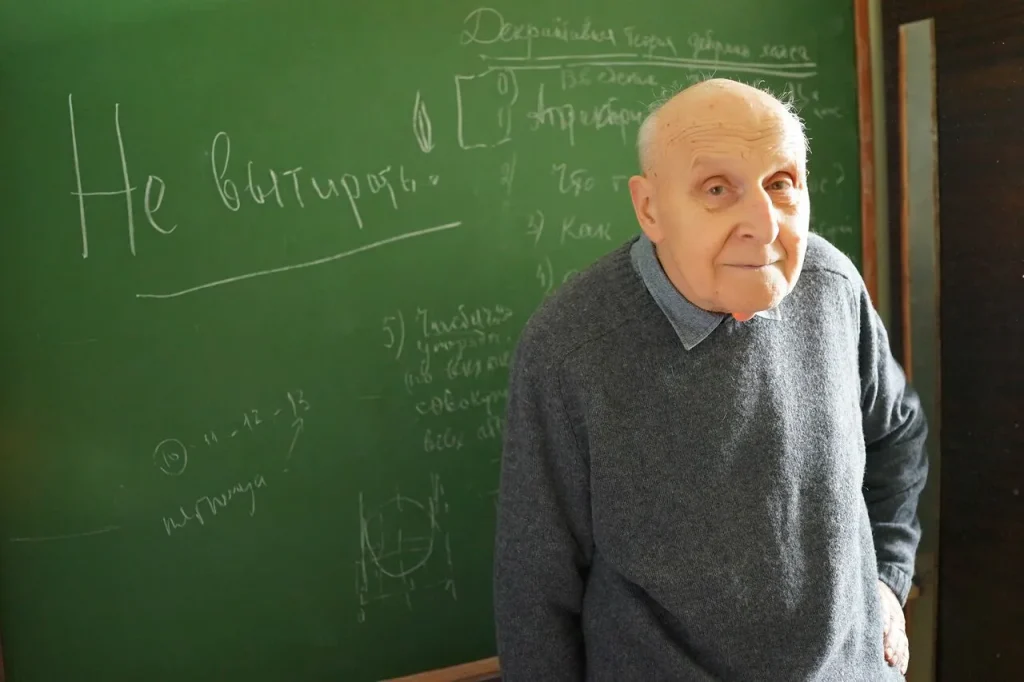
“Sharkovsky ordering” is like the Pythagorean theorem or Newton’s binomial theorem: the name of the leading specialist of the Department of Dynamical Systems and Fractal Analysis at the Institute of Mathematics of the National Academy of Sciences of Ukraine (Kyiv) is forever entered into the history of world science.
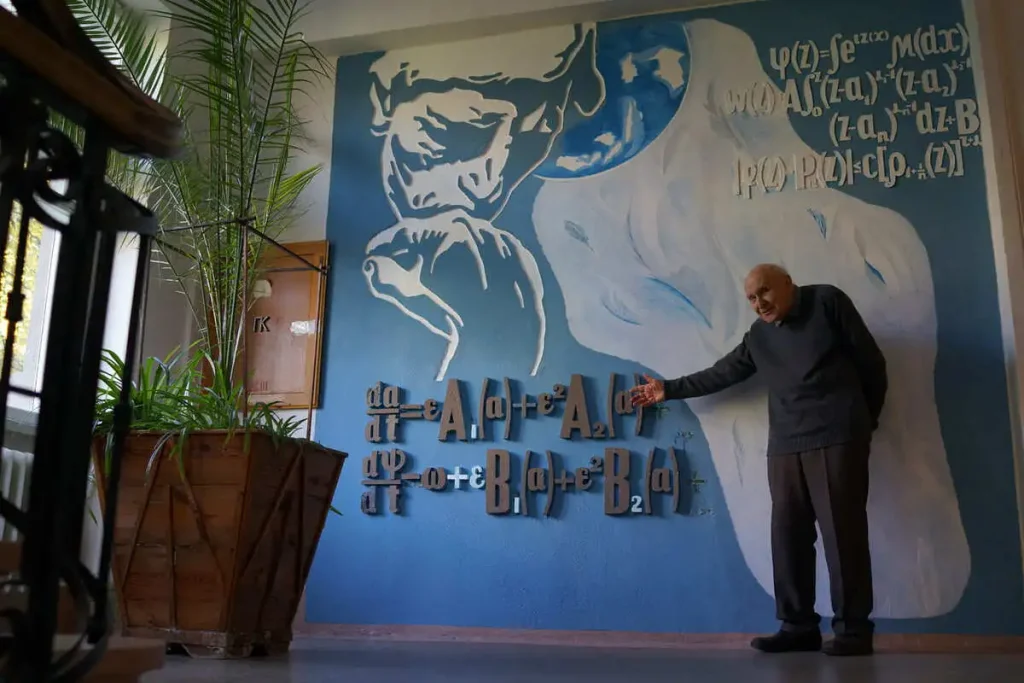
Academician Sharkovsky is an old-school modest person, very kind and, despite his venerable age (in December, in a week, he turns 84), simply beams with humor. At the same time, he cleverly turns away from any topic that does not directly concern his scientific field. As soon as general questions arise, he instantly says, “I’m tired.” No philosophizing — out of the question. No odes to mathematics.
“…phenomena in all their complexity are easily and astonishingly obtained from simple equations that describe them. Not suspecting the possibilities of simple equations, people often conclude that explaining the whole complexity of the world requires something given by God, and not simply equations.” — Feynman Lectures on Physics (1966)
— Oleksandr Mykolayovych, oddly enough, I have learned from acquaintances that you are better known in the West than in Ukraine.
— Most likely, that’s exactly how it is. Perhaps the reason is that my topic, the descriptive theory of dynamical systems and deterministic chaos, is not very popular among our scientists. A department of topology, geometry, and dynamical systems exists only at Shevchenko University, as far as I know. All my students — among whom are 4 doctors and 14 candidates of sciences — have scattered to towns and villages… some in Canada, some in the USA, some in Europe… I now conduct a weekly seminar at the Department of Mathematical Analysis at Shevchenko University, but that, of course, is not enough for the development of the subject in our country.
Yes, in Ukraine I am a laureate of the Bogolyubov and Lavrentiev Prizes of the National Academy of Sciences of Ukraine, and my scientific works are regularly published here. In total, I have written about 250 of them, and now the Institute of Mathematics has published the book “Ideal turbulence: fractal and stochastic attractors of trajectories in idealized models of mathematical physics” in Russian and Ukrainian, co‑authored by my student, Doctor of Physical and Mathematical Sciences Elena Yuryevna Romanenko.
Two books have been translated into English (“Difference Equations and Their Applications” (1993) and “Dynamics of One‑Dimensional Maps” (1997), Kluwer Academic Pub). Soon, my book titled “Sharkovsky Ordering” will be published by the Berlin publishing house Springer, founded in 1842. It is already prepared for printing. I wrote it with Alexander Markovich Blokh, who studied in Kharkiv — I was the opponent for his dissertation, and in the early ’90s he moved to the States, where he lives and works in Birmingham, Alabama.

In 2011, in Canada I was awarded the Aulbach Prize of the International Society of Difference Equations for outstanding contribution to the theory of difference equations and discrete dynamical systems. This Aulbach Prize was awarded for the first time and is now given every two years. In 2014 I was awarded the degree of Honorary Doctor of the Silesian University (Czech Republic).
I am a member of the editorial boards of a number of international mathematical journals, including Bifurcation and Chaos, and co‑editor of the Journal of Difference Equations and Applications (USA). As you see, the entire bookshelf is tightly packed with Bifurcation and Chaos journals, and the price of one copy is $120! So it can be said that in these cabinets there is quite a fortune…
— I was also told, Oleksandr Mykolayovych, that it is thanks to your research that the mesmerizing fractal images were “born”? Today, probably only the blind have not seen or admired them. I was also struck by how complex your theory is to understand — and how much its consequence — fractal images — is in the zone of popular interest…
— Because the pictures are beautiful! At the same time, the algorithm to get beautiful pictures on a computer is very simple: take the simplest polynomial on the complex plane and iterate it. A fractal is what? Merely self‑similarity. And coloring the numerical results makes them very beautiful and allows them to be viewed more deeply, increasing their scale infinitely.
As for the origin of the “fractal trend” directly from my research, that’s not quite so. Yes, I dealt with sets that later became called fractals in my doctoral dissertation. My opponent, Vladimir Igorevich Arnold, knowing that I worked in that area, suggested that I organize and be the editor of the translation of the book “The Beauty of Fractals” (authors Heinz‑Otto Peitgen, Peter Richter).
Iterating, that is repeating simple formulas, the Germans Peitgen and Richter obtained very beautiful pictures by coloring points with specially selected colors. With an exhibition of their printed graphic works they traveled around Germany, after which in 1986 they published the album The Beauty of Fractals, half consisting of scientific articles and half of those mesmerizing images. The Russian publishing house Mir became interested in the book, and since fractals (or what later became called such) were used in my dissertation (1966), I was asked to organize the translation of this book. As a result, it appeared in 1993 in Moscow with my preface and an additional theoretical justification article about fractals. The event was successful; the print run quickly sold out, and soon a second edition was printed. And then “fractal creativity” was taken up by others interested in iterating any formula they liked.

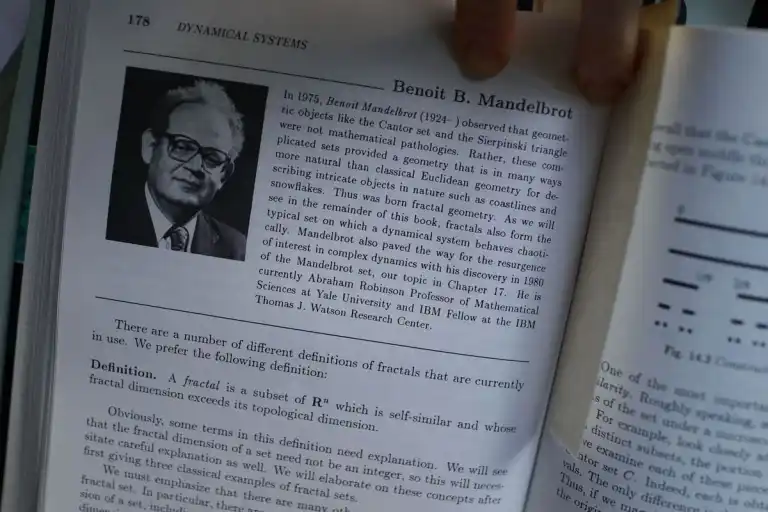
When preparing the book, I visited Peitgen and Richter in Bremen. It would be wrong to assume that there is a direct connection between “Sharkovsky’s theory” and their work. They were based on dynamical systems theory. Benoit Mandelbrot introduced the concept of fractals. And American James Yorke introduced the concept of chaos into mathematics. These two even received the Japan Prize in 2003 (50 million yen, or half a million dollars) for “creating universal concepts in complex systems — chaos and fractals.”
Yorke says that in 1975 he published his article (co‑authored with Li) “Period Three Implies Chaos” without knowing about my work, which was, first, 15 years earlier, and second, my theorem is more precise than in the West. I believe him.
I personally met James Yorke several times, first in 1975 at a conference in Berlin during a joint walk of conference participants along the Spree River. That meeting is mentioned in more than one publication. Then I met him in 1989 in Minneapolis, where Professor of Mathematics George Sell invited me to give lectures in several universities for a month. Yorke invited me to speak at his seminar at the University of Maryland.
A meeting with him could have taken place earlier, back in 1969, when the 5th International Conference on Nonlinear Oscillations was held in Kyiv, attended by more than 400 guests, including many Americans. By that time, I was already a Doctor of Sciences and chaired a section on the qualitative theory of nonlinear oscillations at the conference. Yorke was registered to participate in the conference, but he did not attend in person; his report was included in the conference programme and was published in the Proceedings of the Conference, issued in three large volumes.
Two years ago, in 2018, at a conference on topology and applications in Kochi (Kerala, India), I had another meeting with my colleague.
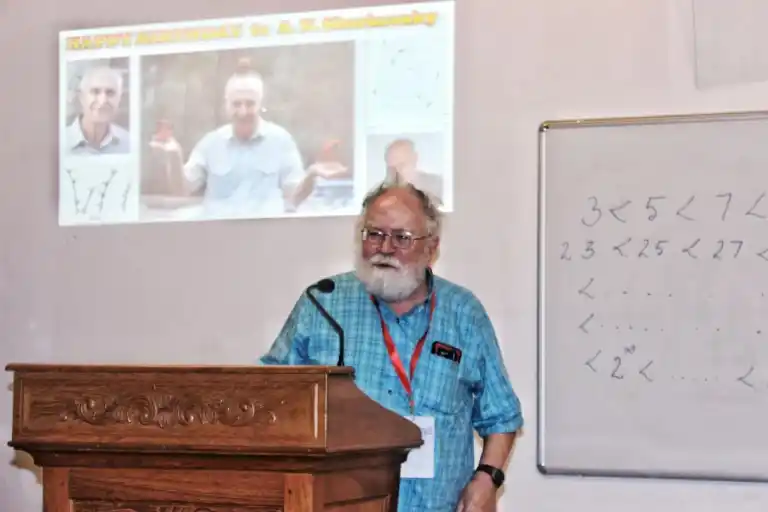

In 1979, an article by Peter Collet appeared in the Bulletin of the Australian Mathematical Society (volume 29) titled On the Relative Order of Coexistence of Sharkovsky Cycles — in it, apparently for the first time, the concepts of “Sharkovsky ordering” and the “Sharkovsky theorem” appeared. This article showed that this order exists not only in one-dimensional systems but is also valid for multi-dimensional systems of a special type, defined by so-called triangular mappings.
In 1992, a book by Professor of Mathematics at Boston University Robert Devaney, A First Course in Chaotic Dynamical Systems: Theory and Experiment, was published, in which everything was described and presented as it is — essentially the first introduction of Americans to colleagues who worked on dynamical systems. It included not only me, but also Yorke and Mandelbrot; it also mentioned the meteorologist Edward Lorenz, who showed that the simplest differential equations can generate this chaos — he is also credited with the now-famous metaphor, the “butterfly effect.”
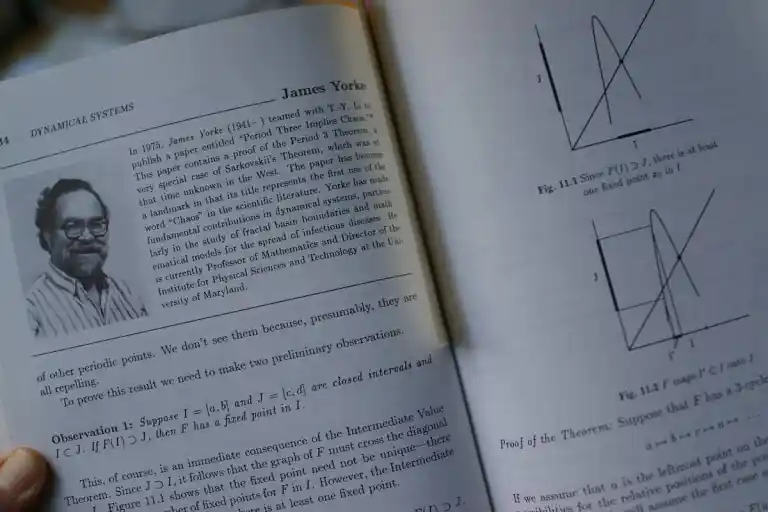
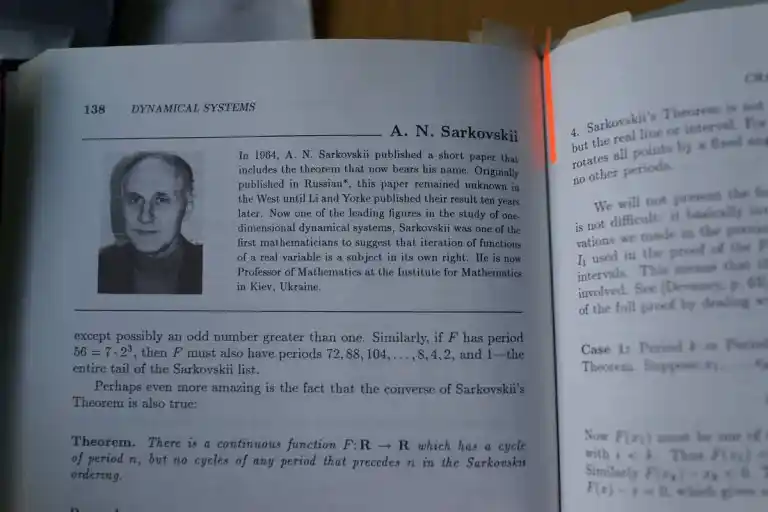
In 1994, the international conference Thirty Years of Sharkovsky’s Theorem: New Perspectives took place in Spain — its reports were published in a separate volume (vol. 5, 1995, of the journal Bifurcation and Chaos), as well as in a separate book in the Nonlinear Science series by World Scientific.
— It’s time to explain to readers what the “Sharkovsky theorem” and “Sharkovsky ordering” consist of. Do you think it’s possible for a science‑popular article?
— It was done quite successfully by the authors of the Polish collection Diamonds of Mathematics, which was even awarded for the best Polish popular science book. One of the 17 articles in it was dedicated to my discovery. It was cleverly illustrated with a picture in which “Corporal Sharkovsky” lines up soldiers not by height but according to his order.
— What is the next number in your order after one? Or which is the first number at all?
— You see, this set is not totally ordered in the mathematical sense. It has both a first and a last number. In my order, all numbers from 1 to infinity are presented, but if you start with 1, then all powers of two follow: 2, 4, 8, 16, … In that case, the system remains simple, its entropy is 0, and only when cycles of periods other than powers of 2 appear does the entropy begin to grow, becoming positive and therefore the system becomes complex. The simplest number, let’s say, is one, and the most complex for one‑dimensional systems is 3. That’s why Yorke’s paper was called “Period Three Implies Chaos.”

— Unfortunately, nothing is clear.
— Yorke’s article was liked by everyone because it was written simply, but it has many inaccuracies. For example, he did not define chaos very correctly: that it is many trajectories overtaking each other. Everything happens much more interestingly and complexly: infinite‑dimensional chaos, a huge number of thread‑trajectories that, like in a person’s, let’s say, brain, intertwine, and as a result form a thinking fabric that allows us to reason.
Dynamic systems help classify and describe these complex processes that occur in nature. Even in three‑dimensional space they can be placed.
— Do I understand correctly that the order of natural numbers 1, 2, 3… was for static systems, and “Sharkovsky ordering” is suitable for dynamic ones?
— Yes, one could probably also say that. You will account for 100 or 1000 parameters, but still will not account for everything.
— Oleksandr Mykolayovych, what is the practical significance of your discovery?
— A good example of what mathematics can do — it describes the movement of air. Air is associated with a continuous medium, though it consists of individual atoms. Systems of partial differential equations (which in general form have no solution) are compiled for a continuous medium; using these equations and boundary conditions (data from meteorological stations), a model is built that accurately describes the motion of masses in space, a solution algorithm is built, and all these data are input into computing machines. A result is obtained. Now I am very pleased with the successes in weather prediction at finite time intervals, for example, for 10 days ahead.
Biological systems also use this order. If one living cell appears, then from it exactly two cells will appear due to cloning. They will also double (clone), four cells will appear, and so on… This is how mass accumulates, which is necessary for the birth of a new quality (for example, in the formation of a human). If the time for bifurcation has not come, it will continue to double, and when they get tired of splitting and realize they can organize themselves differently, then a new quality, trifurcation, will appear, and the topological entropy will increase. The embryo must first accumulate mass; doubling is just like spinning in place, and no energy is spent on it. Trifurcation, however, will cost the system a lot.
— At least it’s clear that your numbering describes real processes. And the language to which we are accustomed is hopelessly primitive. It’s good that scientists have approached describing processes themselves, not their ideas about them.
— I don’t know, I don’t know, philosophizing is not my thing.

— Yes, with lectures “about nothing” you wouldn’t travel to universities in Europe, America, China, Australia and so on… And can you tell, Oleksandr Mykolayovych, how your glorious path began — probably your parents were passionate about mathematics?
— No, not at all. My father worked as head of the technical control department at the G.I. Petrovsky Plant (now – “Kyiv Automation Plant named after G.I. Petrovsky”) in Kyiv and was born in the town of Starodub, Chernihiv Governorate. My mother was from the village of Bilyivka (Biliivka), Skvyrs’kyi povit, Kyiv Governorate (now a Bila Tserkva district, Kyiv region). She worked as a nurse‑housekeeper in the First Regional Hospital of Kyiv, at one time as a coil winder at a factory, and then as a librarian. I was born in Kyiv and studied at School No. 70 on Lukyanivka, which at that time was exclusively boys. In 1953 I graduated from it. I remember that in the 7th grade I wanted to become a chemist.
But then a teacher, having just graduated from the Faculty of Mechanics and Mathematics, came to us and advised me to attend mathematical circles at Kyiv University, held by graduate students and senior students. I began to participate in olympiads. In my first year of participation in the olympiad, in the 8th grade, I received the first prize among students of grades 7–8 in Kyiv. And then my name appeared in the journal Uspekhi Matematicheskikh Nauk (eng. Successes of Mathematical Sciences), published by the Academy of Sciences of the USSR, as a winner of the Kyiv city olympiad. I entered Taras Shevchenko Kyiv University after an interview with a faculty member of the mechanics and mathematics faculty as a silver medalist from school. I remember that during the interview, the teacher did not like my answer to a simple question. I remembered his words for life: ‘These medalists come and then disgrace their schools,’ to which I couldn’t help but reply, saying how I can disgrace my school after receiving the first prize at the city olympiad.




Professor Georgy Evgenyevich Shilov, son of the academician of the Ukrainian Academy of Sciences in chemistry, taught us higher algebra in the first year, and then was invited to Moscow State University. It was he who suggested I make a report on iteration theory: what happens if you take a function and iterate it, what qualitative results can be obtained. The properties of cubic algebraic equations were the topic of another report at the math circle. With this report I spoke at a student scientific conference in 1954 — in general, this is how as a first‑year student I mixed with senior students.
— I heard that to print the article “Coexistence of cycles of a continuous map of the line into itself“, in which the theorem and “Sharkovsky ordering” that made you famous first appeared (and he was only 25 years old then), the printers even had to cast new symbols?
— For the article in the Ukrainian Mathematical Journal (recently I checked — it already has more than one and a half thousand citations!), there simply was no suitable typographic symbol. Then they were cast from lead, so the profession of a typesetter was considered very harmful. The blank I needed was not found, and I simply suggested to “lay on its side” one of the Latin symbols.
I finished the draft of the article in November 1961, submitted it to the journal in March 1962, but it only came out in early 1964. Because the proof was very complicated, and the topologist who was sent to review it spent a whole year reviewing my article… Having received the printed article’s offprints, I went to Moscow to Lyudmila Vsevolodovna Keldysh, the older sister of the President of the Academy of Sciences of the USSR, to consult her on some questions of descriptive set theory. She was a major specialist in the theory of functions of a real variable and topological set theory. I came to her at the Steklov Mathematical Institute right from the train in the morning, and she received me very well. We discussed for more than an hour how complex the behavior of a trajectory in a one‑dimensional dynamical system can be, even though the dimension is one: the intertwining of trajectories is very complicated. It was necessary to involve descriptive set theory, which she worked on and on which she wrote a monograph.

After the conversation with Lyudmila Vsevolodovna Keldysh, I prepared the article On Attracting and Attracted Sets. The article was sent to the journal Reports of the Academy of Sciences of the USSR. Within a week it was presented for publication by Pavel Sergeyevich Alexandrov, one of the creators of descriptive set theory, the very one who first in 1916 proved that the Cantor set has the cardinality of the continuum. After that, it is just a flight of fantasy…
— So, physicists say: “flight of fantasy,” mathematicians are already very far from reality.
— From reality — perhaps. In our world the dimension is three, and for mathematicians it costs nothing to think about any dimension! I recall the so‑called “Luzitania affair” in the 1930s, the persecution of the outstanding mathematician Nikolai Luzin — who, by the way, trained a whole galaxy of scientists: Andrey Kolmogorov, Pyotr Novikov (husband of Lyudmila Keldysh), Pavel Alexandrov — accused of “idealism leading to a crisis in the foundations of mathematics”… They say he was engaged in overly abstract things. For me, it is one property of a phenomenon, and the “lysenkoism” of the late ’40s is along the same lines, when, for some of their notions of “reality,” they simply destroyed the remarkable geneticist Nikolai Vavilov…

What I did was reorder the natural numbers. I showed that another order arises naturally, characterizing the evolution of dynamical systems from simple to complex. The simplest way is halving or cloning. Cells reproduce — that’s how mass is accumulated, and a new quality is obtained in another way. My order, although named as such, actually describes chaos: how chaotic motion arises. From the perspective of mathematics, a human being is an infinite‑dimensional system with a huge number of parameters, even in the brain — billions of neurons and dendrites connecting them… Their trajectories are very tangled. On the one hand, everything is chaotic, on the other — there must be order to obtain information and manage the enormous number of cells in a human. That’s how the world is arranged; I can say everything is very complex. And chaos appears already at quite a low level. Order indicates the direction of the complication of systems, their evolution. There is such a concept as topological entropy, which characterizes the complexity of the system.
“Sharkovsky ordering” arose from the study of one‑dimensional dynamical systems. My former postgraduate student Vasily Bondarchuk transferred what I obtained for one‑dimensional dynamical systems to any dimension but under two conditions: smoothness and expansion. When dynamical systems stretch in all directions, it’s possible to obtain what cannot be obtained for ordinary systems with both stretch and compression. Doubling the angle on the circle is a simple example.
I dealt more with difference equations, where time is discrete and space is one‑dimensional. If you consider difference equations of one real variable — then this order applies to them. It characterizes such a transition of a dynamical system from simple to most complex. In the process of evolution, deterministic chaos arises.
The mapping of space into itself occurs as points, and so we obtain a trajectory from these points. And what? With the introduction of the concept of proximity, an attractor appears in the trajectory, and since an attractor can attract many trajectories, then one can speak of the basin of that attractor.
In the simplest system, the attractor is single, like a drain in a bathtub (and everything drains to that point). But there can be different attractors to which different trajectories are attracted. Some trajectories are attracted to one, and some to another. And the basins of different attractors can be very intricately intertwined. The basins intertwine, and that’s why a way was needed to describe the structure of these basins — the so‑called theory of chaos, based on the use of descriptive set theory.
A simple example — doubling the angle on a circle — is also an example of the most complex dynamical system from the point of view of descriptive set theory.
— Oleksandr Mykolayovych, as far as I know, “scientists” who burn out after the first dissertation, and you, with such enthusiasm about your science, you tell about it that I almost understood everything! How do you manage it?
— I don’t know. Probably because I started from the simplest, and then, in the course of work, had to solve increasingly complex problems. Therefore, the interest did not fade.
— And I have saved the simplest question for the end of the interview: for whom do mathematicians work?
— Ask Euclid. To bring order, probably. To develop and enrich the language of mathematics, to fill it with concepts that would allow the most adequate description of phenomena and processes, more and more. Mathematics is the science of mathematical models.
The development of the language of mathematics has occurred continuously, and their inventions have been found very useful. Didn’t I read in your Granite about Torp, who devised complex calculations on how one can inflate a random system, still using some statistics?

The results of O.M. Sharkovsky’s doctoral dissertation defended in 1967 formed a significant part of modern topological dynamics and led to the creation of a new direction in dynamical systems theory — combinatorial dynamics. He authored works on the theory of dynamical systems. His research in chaos theory conducted as far back as the 1960s significantly outpaced similar research by American mathematicians.
He established the foundations of the topological theory of one‑dimensional dynamical systems, a theory that today is one of the tools for studying evolutionary problems of various nature. He discovered the law of coexistence of periodic trajectories of different periods; explored the topological structure of basins of attraction of various sets; and obtained a number of criteria of simplicity and complexity of dynamical systems. O.M. Sharkovsky also has fundamental results in the theory of dynamical systems on arbitrary topological spaces.
The achievements of the Ukrainian scientist received universal recognition in international scientific circles. His name is associated with the formation and development of chaotic dynamics. In scientific literature one can encounter terms such as Sharkovsky theorem, Sharkovsky order, Sharkovsky space, Sharkovsky stratification, and others. The Sharkovsky theorem is associated with the beginning of the new direction in dynamical systems theory — combinatorial dynamics.
The research conducted by O.M. Sharkovsky allowed him to propose the concept of “ideal turbulence” — a new mathematical phenomenon in deterministic systems, which models in time and space the most complex properties of turbulence, namely: the processes of formation of coherent structures of decreasing scales and the birth of random states.
The scientist always actively combined scientific work with teaching, from the mid‑1960s giving general courses and lectures on the theory of dynamical systems at the Faculty of Mechanics and Mathematics of Kyiv University and regularly accepting invitations from universities in the USA, Europe, India, China, and Australia. In total, the scientist visited more than 20 countries, investing much energy and time in strengthening scientific ties with outstanding colleagues around the world.
translated from an article written by Daria Tarusova, published 29.11.2020, source Granite of Science
перекладено зі статті Дар’ї Тарусової, опублікованої 29.11.2020, джерело Granite of Science