
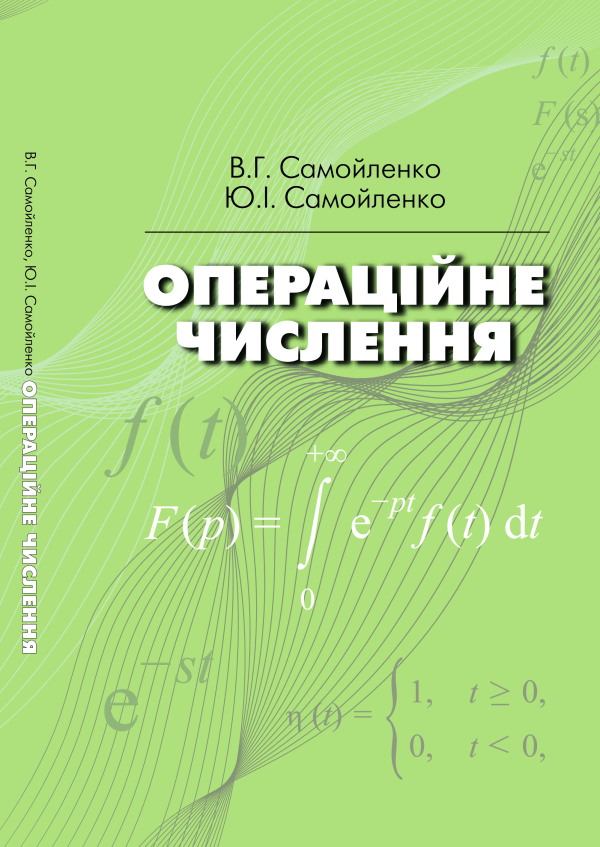
OPERATIONAL CALCULUS
Valerii SAMOILENKO, Yuliia SAMOILENKO
|
This textbook provides a systematic exposition of the theoretical foundations of operational calculus and its applications. It begins with the fundamental concepts of complex analysis required for the study of operational calculus, including residue theory, formulas for computing residues, and Cauchy's residue theorem. The Laplace transform is then introduced, and its principal properties are examined, including linearity, similarity, Laplace transforms of derivatives and integrals, translation and shifting properties, integration and differentiation of transforms, differentiation with respect to a parameter, and the Laplace transform of a function convolution.
A separate chapter is devoted to the computation of Laplace transforms of special functions used in mathematical analysis, the theory of differential equations, probability theory, mathematical physics, optics, and highway engineering. In particular, the Laplace transforms of the power function $t^\alpha$, where $\alpha \in (-1,+\infty)$, and of the characteristic functions of random variables with uniform, exponential, gamma, Erlang, and $\chi^2$ distributions are obtained. The Laplace transforms of the $ \sin $ integral, the hyperbolic $ \sin $ integral, the Fresnel integrals, and the probability integral are also evaluated. The problem of recovering the original function from its Laplace transform is considered. Mellin's theorem is proved, the application of the Mellin integral to recovering the original function is presented, and the first and second expansion theorems are established. The application of the Laplace transform to the solution of initial value problems for linear ordinary differential equations and their systems, linear integral and integro-differential equations, boundary value problems for the wave equation describing string vibrations and the heat equation for a finite rod, as well as problems in the analysis of electrical circuits with series and parallel connections and circuits with inductive coupling, is demonstrated. The theoretical results are illustrated by numerous examples. Each chapter concludes with review questions and exercises for self-assessment and independent study. The textbook is intended for students of mathematics, physics, and engineering, university instructors, and all readers studying operational calculus independently. This publication was supported by the Targeted Comprehensive Program "Transformation of the Scientific Publishing Complex of the National Academy of Sciences of Ukraine under Conditions of War and Post-War Changes in the Context of the Implementation of European Open Science Initiatives" (2026–2030). |
Kyiv, Akademperiodyka, 2026
ISBN 978-966-360-576-0
UDK 517 (075)
File:
https://imath.kiev.ua/books/2/book.pdf
DOI: https://doi.org/10.15407/akademperiodyka.576.157
Editor O. A. Mykytenko
Рецензенти:
V. M. Boyko, Doctor of Physical and Mathematical Sciences, Senior Research Fellow
P. F. Samusenko, Doctor of Physical and Mathematical Sciences, Professor